My takeaways from Strong Ground
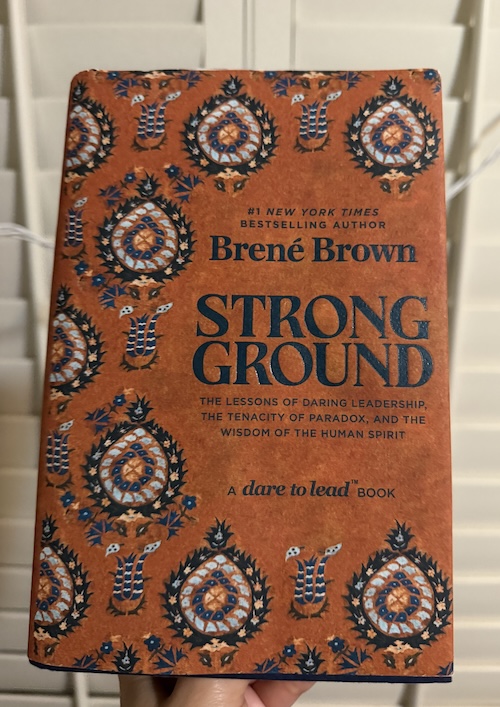
I really liked this book. Not necessarily because every section was groundbreaking for me, but because there were several ideas that made me stop and think, “Oh. That’s me.” Or, maybe more importantly, “I should pay more attention to that.”
Above or below the line
One of the ideas I keep coming back to is being above or below the line when it comes to fear.
Above the line doesn’t mean you’re not afraid. It means you recognize the fear and understand that it’s there, so you’re not unconsciously letting it drive your behavior. Below the line, fear is still driving, but you may not even realize it.
I like that distinction because it’s not really about eliminating fear. It’s about awareness. Am I making this decision because it’s actually what I want to do, or am I protecting myself from something?
That also connected for me to the larger idea of how disconnected we can become from our human wisdom, creativity, joy, poetry, and from actually wanting to be with other people. I’m still thinking about why I checkmarked that section, but clearly something about it landed.
Executive presence might actually be preparation
This was probably one of my favorite parts of the entire book because I felt VERY seen.
There’s a story about someone asking about executive presence and essentially wondering, “How do you develop that?” The answer came back to preparation. One person spent about 20 minutes looking at an agenda and jotting down questions. Brené described spending much more time (2 hours at least!) going deep and really preparing.
And I thought: YES. THIS.
I prepare a lot. I go down the rabbit holes. I think about what people might ask, what I need to know, what could go wrong, and what connections I might need to make.
Sometimes I probably think I’m overpreparing. But this reframed it for me. What looks like natural confidence or executive presence from the outside may actually be the result of a tremendous amount of work before anyone walks into the room.
I really like thinking about preparation as one of my strengths rather than something I need to apologize for.
The limits of my language
Another idea I loved was the Wittgenstein quote about the limits of my language being the limits of my world.
That hit me especially around emotions.
For a long time, my emotional vocabulary probably consisted of some version of mad, sad, happy and anxious. ? And this is what Brene said! I’m getting much better at it, but if I can’t actually identify what I’m experiencing, it makes sense that it’s also harder to process it.
It makes me wonder how much expands when you can get more specific. Maybe I’m not just anxious. Maybe I’m overwhelmed, uncertain, disappointed, vulnerable, anticipating something, frustrated, or overstimulated. Those things don’t necessarily need the same response.
Anxiety, worry and avoidance
I also found the discussion about anxiety interesting, especially the differences between anxiety as something we experience in a moment, anxiety as more of a trait, and anxiety disorders.
But the part that really got my attention was the connection between anxiety and worry or avoidance.
Hello, avoidance. ?
I absolutely know that pattern in myself. Something makes me anxious, so I don’t want to deal with it. And sometimes I worry about it AND avoid it, which is obviously a highly efficient system. ?
There’s something useful about being able to recognize the pattern without immediately judging myself for it. If I notice myself avoiding something, maybe the question isn’t just, “Why am I procrastinating?” It might be, “What about this is making me anxious?”
That feels like a much better question.
Perfectionism vs. excellence
I loved this distinction:
Perfectionism: What will other people think?
Striving for excellence: What do I want?
That’s one I want to remember.
Because I genuinely love learning and mastering things. I can become slightly ridiculous when I get interested in something because I want to understand ALL OF IT. But there’s a difference between doing that because I’m fascinated and want to get better, and doing it because I’m worried about how other people will judge the result.
The discussion of mastery resonated with me for the same reason. Mastery requires endurance. You keep learning and pursuing something because there is actually joy in getting better at it.
That feels very me.
Grounded confidence and mental rehearsal
I also really liked the idea of mental rehearsal, especially visualizing not just the perfect version of something, but the obstacles.
What could go sideways? What question could I get that I don’t expect? Where might I get uncomfortable? How do I want to respond?
I already do a lot of the preparation piece, but I think I could do more actual role-playing rather than just thinking through everything in my head.
Preparation gives me information. Rehearsal could help me practice how I want to show up.
Don’t get so locked into creating that you forget who you’re creating for
The section on creativity and innovation was another good reminder.
When we’re really locked into making or solving something, it’s surprisingly easy to lose sight of the actual people we’re doing it for.
The idea of starting where people are and putting empathy at the center of the process feels incredibly simple, but it’s also something I want to remember. Especially because I LIKE getting deep into the work. Sometimes the challenge is stepping back out of it and looking at it through someone else’s eyes.
Lock-in, but learn how to lock-through
This may be the idea from the book that I need to work on the most.
I know how to lock in. Give me something interesting, complicated or important and I can go incredibly deep. I can focus and work and think and keep going.
What I don’t think I do nearly as well is lock through, meaning transitioning out of that state.
I totally understood the example of having a hard day, getting home, and sitting in the car scrolling instead of going inside. It’s not necessarily that you don’t want to go inside. Your brain hasn’t transitioned yet.
That was kind of an aha for me.
Deep focus has a cognitive cost. Recovery isn’t separate from the work. It’s part of the work.
And the flashlight analogy really worked for me too. If attention is a flashlight, I can’t shine it intensely on five things at the same time and pretend I’m deeply focused on all of them.
One flashlight. One thing.
Protecting my thinking also means protecting my energy
Related to that, I loved the discussion about deliberate practice, fatigue, and protecting your thinking.
The chess example about games being won or lost late because fatigue causes mistakes really resonated with me. I absolutely reach a point where my brain just goes, “Nope. We’re done here.”
And sometimes I keep going anyway.
Maybe protecting my time isn’t enough. I need to think more about protecting the quality of my thinking.
Not every hour of my day is equal. And if I’m doing work that requires deep thought, judgment or creativity, I need to pay more attention to when I’ve hit the point of diminishing returns.
I need a transition ritual
The story about asking for 30 minutes alone after coming home stuck with me too.
I don’t necessarily need that exact solution, but I think I need some version of a lock-through ritual.
Something that tells my brain: work is finished. You don’t have to immediately become productive in another area of your life. You can transition.
That may be something I need to experiment with.
And finally: staying spiritually fit
I liked that the idea of being spiritually fit wasn’t necessarily about religion or faith. I took it more as: What keeps me grounded enough to stay above the line?
What practices help me notice when I’m protecting myself, acting from fear, depleted, avoiding, or just not quite myself?
I don’t think there’s one answer. Maybe that’s actually the point. It’s having enough self-awareness and enough strategies that I can recognize when I’m slipping below the line and know how to find my way back.
What I think I took from the book overall
Looking back at everything I marked, I think my biggest takeaway is actually about how I want to operate.
I want to prepare deeply, because preparation gives me confidence.
I want to pursue mastery because I genuinely love learning, not because I’m worried about what other people will think.
I want to notice when fear or anxiety is quietly driving my behavior instead of pretending it isn’t there.
I want to get better at naming what I’m actually feeling.
I want to lock in deeply when something deserves my attention, but also respect the recovery that kind of focus requires.
And maybe most importantly, I want to become as intentional about coming out of intense focus as I am about going into it.
I already know how to go deep.
The next thing for me might be learning how to come back up. ??
