I started in October 2025… At some point, I made an effort to really read/finish a chapter at the dinner table. It did not work but still, I got here somehow. I resolved to actually write down what I liked about each and every one of these dang chapters so I can better remember it later and keep myself accountable to actually finishing this dang thing.
Is this one of the most abandoned nonfiction books ever? It may be. Wow.
TL;DR
I’m giggling. I know I will come back and skim this 2 or 3 times over the next 5 years. Self, what chapters should I go skim or re-read?
- Ch 3 with the parole judges and how glucose affects your systems is probably the one study I remember the most.
- Ch 16 made me stop and think and re-read about stepping forward in startling moments and addressing stories to individuals rather than statistics. (Politics does this well!)
- Ch 17 is my shouting “Regression to the Mean” to sound smart. Also, don’t yell at people!
- Ch 21 – totally obsessed and I created a spreadsheet on how to conduct my current interviews which freaking cracked me up. I did go with the highest scoring candidate though. But was it my intuition or actually following the process? Who knows.
- Ch 23, what a good lesson. People’s state is a form of lethargy – just an unwillingness to think about what may happen in the future. That feels SO business to me. We are always so optimistic about the odds of us succeeding and… what happens? We need to consider it more.
- Ch 35-38, the whole ending of Remembering self vs Experiencing self is so true, so fascinating, and the studies are bananas. But loved all the call-backs to happiness.
Summing up this book?
Confidence is a feeling and the evidence in front of us is COMPELLING. And we BELIEVE IT. Even if we are proven wrong.
I’m very impressed I finished this book AND wrote about it. Gorgeous achievement for 2026!
What will change because I read this book? Damn. Hmm.
- I will structure interviews or things that I need to pick better
- I will watch for anchoring
- I TOTALLY notice regression to the mean – ha
- I will be distrusting confident forecasts
- I am going to think about the Remembering self. But that is a longer discussion.
What will I read next though… #INeedABreak
Probably a memoir to cleanse and then I will pick another leadership / critical thinking book. Wow.
This was SO HARD!
Anyway, here are my notes:
Chapter 1 – System 1 (automatic, judgement) and System 2 (effortful, choice). My intuition will always jump through with my System 1 before I made a conscious effort to bring up System 2 to think things through.
Ch. 2 – I LOVED his tests that the pupil of the eye is the window of the soul. They were able to see the arousal of your pupil when you hit the crux of your thinking brain. They were able to joke with people and ask, “Why did you stop working now?” Because they have a window to your soul!
Laziness is built deep into our nature.
With ego depletion, you have a lazy controller. In Ch. 3, I was fascinated to read that glucose has been proven to undo the effects of ego depletion – the effort of will or self-control is so tiring that once you do something, the inclination to do more goes down dramatically. In fact, they tested it with parole judges in Israel and the most approved requests spike after meals, and go down to nothing after that.
So clearly, rewarding myself with sweets to do hard things is a good thing. Ha.
I really liked how this author covered so many studies. They were super fascinating to read about. The point at the end of chapter three was that there was a big difference between intellect and rationality and how we jump from System 1 and System 2 in our brains.
December… Okay, I got stuck and stopped reading. But I’m back at it!
Ch 6 and 7 were interesting to lay out the fact that we easily jump to conclusions with System 1, and any information we get, we think what we see is all there is. The halo effect is real (and has been studied for years) and unless we take steps to negate it, System 2 will be lazy and step back and let System 1 do all the work.
Judgements are so true. We are automatically judging from S1 on how attractive people are, on if we like one aspect of them (how we will like another aspect), and other things. It’s when our S2 comes into play that starts to stump us. With answering questions, we usually have our intuition to quickly guide us even though it can be often wrong. And we attribute the emotion of it all GREATLY to influence us.
And this makes me laugh because I must obviously just think with S1 all the TIME? Eek.
S1 is CONSTANTLY working, super fast, requires little to no effort, having gut feelings if something is right or wrong. I’m seriously System 1 in a nutshell.
Well, now it’s time to get to the System 2 section! Actually, I guess it’s basically the “bias” section. Fascinating.
January 2026 – Still a struggle but I am resolved! I really do like these studies, it’s just taxing reading!
Anchoring! Ahh, I loved the chapter on anchoring. I’ve always been fascinated by the theories of putting 3 numbers together – one ridiculously high, and two comparable where there is one obvious choice to buy. This didn’t talk about this scenario but proved out really interesting studies where they anchored people to a number and showed where people got stuck to it.
I also appreciated the advice that if the number starts high in negotiations, don’t counter with a crazy LOW number, just threaten to walk out and get them lower, because starting with a high anchor is always a bad idea.
Ch. 12 was on the availability bias, or the science of it. Basically explaining how when we hear of plane crashes, we think crashes are more likely to happen. But it was interesting in showing the studies of asking people for 6 times they were assertive, and to rate how assertive they were. But when you asked for 12 times, it was harder to come up with the availability of ideas, so you rated yourself as less assertive. Weighing your S1 against S2, and all the little nuances that affect both of them.
I read 13 and 14 together and it was a lot of comparing things, which was difficult but still really interesting studies. It was really proving out that the “emotional tail wags the rational dog” which made me laugh. But it’s true. We often have an earthquake and then panic about insurance. Or safety things. But then after a few months we forget again. And seeing representativeness, where we take what we like and then assume good things (or vice versa!) happens all the time. Again, each chapter really dives into interesting (if a little mind-numbing) studies.
Ch. 15 was pretty good but i had to keep reading it over again. It was about a famous controversy where they used “Linda” as an example of probability but many understood it to be plausibility. Essentially that our intuition overcame logic even in a joint evaluation if it had a good story behind it. Basically S2 is SUPER lazy and not impressively alert.
Ch 16 started off with a math problem and probabilities – They were in fairly whole numbers which was nice but still, made my head hurt. But this chapter included one of the authors favorite studies. It’s about a complex situation where basically it’s showing multiple people alone, hearing another person in trouble. Most of the people assume everyone else will “help” the person in trouble and what happens is that only a small amount step forward. I have found that I have been reluctant to step forward at times when something startling happens (which in turn, has forced me to consider that and step forward in new situations) but the point of the study goes on to teach other people and it’s fairly unsuccessful. They go about it two ways, one is presenting what happened to people with a statistical bent and the other is showing what happened, telling them about the results, and then the people predicted more correctly. SO deducing the particular from the general was unwilling, but more peope were willing to infer the general from the particular.
Kind of hard to wrap your brain around it – and much easier to read his whole layout of it – but it’s more effective and powerful to address situations to the individual rather than learn anything from statistics – more impersonally. It makes sense and again, why this book is so fascinating with the situations it portrays and how it gives us questions in every chapter designed for us to think it through before we go learn about it.
Ch 17 made me laugh. Regression of the mean is absolutely outrageous. It’s true but it’s admittedly not fun and hard to remember and believe. It starts out with the Israeli Air Force doing a training with the author and one bigwig insisting that criticism is more effective than praise because when you yell at someone they get better, yet when you praise them for doing an amazing job, they usually do worse. Because most of us regress to the mean. Basically, doing really bad or good is a mixture of luck and skill and most likely you are going to do the opposite the next time. Even if just by a little. There were some other hilarious examples and a lot of repeats of “correlation” and regression and stats, but basically Sy1 and Sy2 both have a hard time with the concept because Sy2 find it difficult to understand and actually learn, and it’s totally against how Sy1 works.
It will be something interesting to remember!
This book is taking me so long, omg. And yet, it’s fascinating.
Ch 18 – I now want to go around saying “there is a lot of room for regression” very importantly to people. This chapter was another reminder that our Sy1 wants to wildly and funly (funly? ha) have amazing predictions about people and things but we have to tame down our intuitive side and be cautious. Being cautious is NO FUN but I feel like it would make me sound very smart. Sadly, I would never follow the advice, I’m a total Sy1 girl. Either way it’s a good reminder!
Ooh, I graduated to Part 3, Overconfidence. Which clearly is going to chop my ego in half.
I’m not even half-way done with this book. Onward.
Ch 19, the Illusion of Understanding. I was too behind, so I read this immediately after Ch 18. Definitely a hit to the ego. Hindsight! The stories we tell ourselves. Blah blah. I had to laugh where it said, “It is easier to construct a coherent story when you know little, when there are fewer pieces to fit into the puzzle.” Isn’t that the truth! Our Sy1 makes up narratives to suit our world view. Our hindsight bias gives us a tenancy to revise history in light of what actually happened. Le sigh. Yes, I concur.
What is our recipe for success? We have to continue to insert the ‘regression to the mean’, how averages work, and what role luck plays.
I feel like these two chapters have taken me more than an hour because I kept picking up my phone and distracting myself. Taking a break!
Ch 20, the Illusion of Validity went over stock pickers! Ha! Why do we (the collective we) think we can pick stocks better than anyone else? Confidence is a feeling and the evidence in front of us is COMPELLING. And we BELIEVE IT. Even if we are proven wrong, even if we look at stats that tell us the truth, we immediately go back to what we see and feel and think is right. Yayyy Sy1! The coherent story in our minds is strong.
Some of the parts in this chapter made me giggle. It was a LONG chapter, don’t get me wrong, but when facts challenge our basic assumptions – and threaten livelihood and self-esteem – these facts are just not absorbed.
And that is totally true for me. The author had a funny story about an exercise he did in judging people’s future after watching them in an exercise for an hour. He simply didn’t believe that what he was seeing in front of him wouldn’t play out, even though stats 9 months, 18 months, 4 years later showed him his guesses were just that, guesses. We can accept facts intellectually but it didn’t have an impact on our thoughts and feelings, or future actions.
Ch 21 – OBSESSED with this chapter!!! Your intuition vs a formula. Which is better?
OBVIOUSLY MY INTUITION. Come on, now!
What? It’s not? That’s the whole premise of this book but I’m just laughing at myself, it proves all these points about formulas being better and how even when it’s proved out, we don’t believe it. But the inconsistency of rating is believed. Radiologists evaluate x-rays and contradict themselves 20% of the time. We are inconsistent beings! If we get a cool breeze on a hot day, it makes us more positive.
One that made me laugh was simple equally weighted formulas based on existing statistics are good predictors. IN a memorable example, one person showed that marital stability is well predicted by a formula:
frequency of lovemaking minus frequency of quarrels
I mean, I had to laugh. You don’t want your result to be a negative number! Thank you, book!
The Apgar rating for newborns was created in this fashion. But when we know computers are running things we just don’t like it. And we an see this with AI (this book was written before AI! Imagine that) but I like the point it makes that for most people, the cause of a mistake matters. The story of something bad happening (a child dying) because of an algorithm is more poignant than when it’s human error.
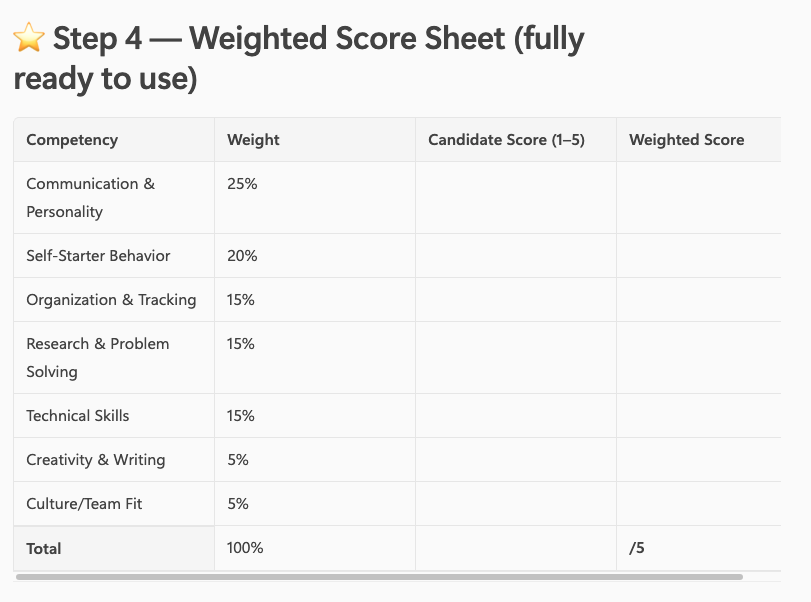
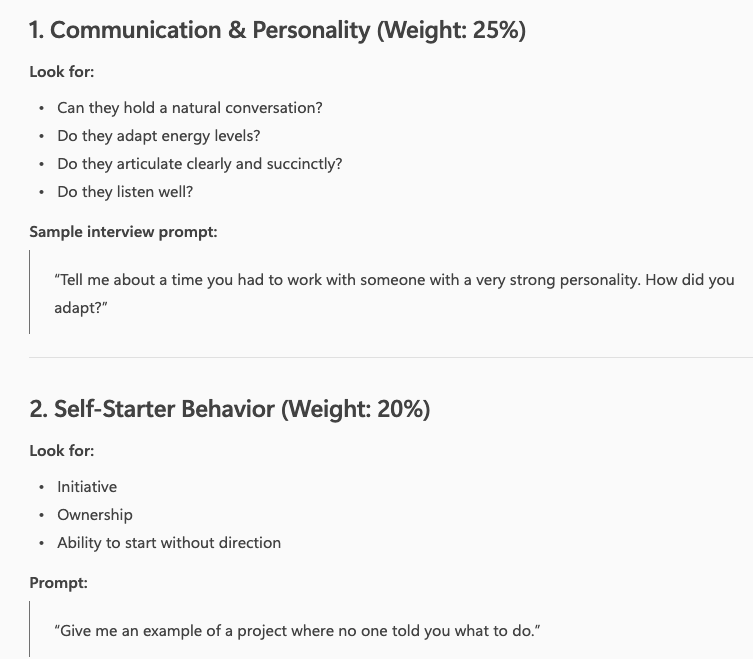
Anyway, there were a few examples about hiring people and using formulas vs intuition and I am interviewing for a new person on my team TOMORROW! I have 5 interviews over three days. So I asked AI to make me a formula with questions to ask so I can rate my interviews!
I’m kind of thrilled. We shall see if I use it and if I trust it more than my intuition!
Ha, the next Ch 22 is “Expert Intuition: When an we trust it?” but these chapters are so long, I’m not going to read it tonight!
Five days later…
February
This was a good chapter because it was about when we can trust intuition. Essentially, when people have enough time to learn through practice, and an environment that is predictable.
Things like doctors, nurses, athletes, and firefighters are people you can relatively trust their intuition at. Where people like stock pickers and political scientists have less trust. The quote being “Intuition is nothing more and nothing less than recognition” is fairly apt. It is the norm of our mental life to take our history and apply it. But it was a good refresher!
“The Outside View” for Ch 23 was essentially short and sweet. Basically saying that we have an inside view of what we feel about projects, or things we are doing. But we rarely take the outside view to better honor information. Basically remodeling your kitchen and getting a quote but at the end, it costs 3x as much. I liked at the end where he described people’s state is a form of lethargy – just an unwillingness to think about what may happen in the future. That feels SO business to me. We are always so optimistic about the odds of us succeeded. In why people start a new business, why they start wars. etc.
Ch 24, the Engine of Capitalism is the last chapter in this part. It was actually pretty sweet in how it went over that optimistic people are amazing people. They are lucky people because they already feel fortunate. They play a huge role in shaping our lives however they have an optimistic bias that plays a huge role, especially in starting their own business. They ignore the risks and think they are better and can overcome anything. It’s over confidence and it’s valued much more highly than uncertainty. No one likes someone who says they don’t know something. They want certainty. And the main benefit of optimism is recovering from setbacks, or being resilient.
One remedy of this is doing a “premortem” when coming up with plans. “Imagine we are a year into the future. We implemented the plan that now exists. What went wrong?” – Love that!
Going into Part 4: Choices
Ch 25 was interesting but I read it when I was EXTREMELY tired. But essentially about decision making and the theory of when people would gamble on their utility, and what the value is. Interesting because he went over the error of this famous study that people still use today. The gamble really depends on your reference point and if you would be gaining or loosing. Sounds simple but the point is that many of us give these theories the benefit of the doubt because disbelieving is hard work and Sy 2 is very easily tired!
Ch 26 continued on with finding the error of Bernolli’s and dealing with prospect theory. Essentially that his theory ignored the reference point at which all options are evaluated. When all options are bad, we become risk seeking yet most times all of us are incredibly risk averse.
The Endowment Effect, Ch 27, started off comparing your income (salary) to how many days off you get a year. It went through a few exercises but basically was teaching that people value things more highly just because they own them. Losses loom much larger than gains and the pain we feel is much more intense.
This author feels that loss aversion is the most significant contribution of psychology to behavioral economics in Ch 28, Bad Events. Our brains give priority to bad news. There was a huge study done on golf, that involved Tiger Woods, lol, that compared how much harder golfers worked to avoid a bogey rather than to achieve a better score (a birdie). And there was some funny research about how strangers who observe bad behavior totally get off on joining in to punish the offenders.
Moving on to Ch 29, the Fourfold Pattern. This was semi-interesting just because it continued to go over the decisions weights that we assign to outcomes are not identical to the probabilities of the outcomes. The intensity that we focus on the FAINT sliver of hope is different on the other end of the spectrum. So the author and his partner created this patterns to track it. It went over how we are willing to gamble (like on a lottery ticket) which made me laugh because every time I buy a lottery ticket is the best hour spent dreaming on what I’d spend it on, haha.
It started to talk about rare events but I guess we get a whole chapter dedicated to that in Ch 30! Our obsessive concerns with terrorists, when things are painted in vivid images and makes us imagine the outcomes, being very specific i outcomes (1 out of 1,000 – rather than .001%) all contribute to us overweighting outcomes. Our Sy1 narrows in on ‘how many’ rather than ‘how likely’.
Getting closer! I did two chapters today! Can I do the same tomorrow? (Yes! I did!)
Risk Policies in Ch 31. I did have to get AI help with this chapter but it delighted me that I can ask my AI friend super dumb questions and get easy explanations and it seems to know every single detail about this book. Damn. Anyway. Consider all large risks with a broad frame, so don’t take gambles one-on-one, and think like a trader or CEO… the long-term risk is mitigated or lessened when everything is considered together so have a very firm risk policy and then just GO FOR IT.
As a tangent, I totally check my stock account MULTIPLE times a day. It’s a sickness. But I found that if I set my excel chart up that each account is basically a percent higher, I won’t check as much because I know there is no way I surpassed that. So any day where the market is roaring and prices are going up, I’m obsessively checking it. And the days it’s down, I just don’t look as much. So that was fun to realize – or I already knew it – but fun to recognize as I read this chapter. The emotional upheaval to risk aversion is interesting.
Ch 32 (Keeping Score) had no MATH therefore I did not need AI. Ha. This was about keeping score and all about the sunk-cost fallacy that keeps people making dumb choices because we are emotionally tied to things. It went over regret, blame, and responsibility feelings. It was kinda funny, it talked about different scenarios and where people blamed others or where they would have more regret.
It usually came down to if we stayed with the default option (usually doing nothing) or ACTING. The bias appears in many contexts. The enhanced loss aversion is embedded strongly and originates in our Sy 1. We are constantly anticipating and trying to avoid emotional pains that we inflict on ourselves.
ha ha.
Yes we are.
It does talk a little about how we generally ANTICIPATE more regret than will actually happen because there is a psychological immune system that we deploy to make ourselves hurt less. HAHA. Sigh.
I’M SO CLOSE TO BEING DONE. SO CLOSE. CAN I FINISH THIS WEEK? Or at least do 2 more chapters tomorrow on President’s Day?
On to Ch 33, Reversals. Basically evaluate everything together to get a better sense of what is justified. We got a lot of hysterical examples.
Ch 34, Frames and Reality, probably a continuation of 33? We shall see. But it’s a 12 page chapter and I definitely can’t do it today. Way too long of a day.
Okay, this was long but had some interesting diagrams and a lot of examples. How we frame things absolutely determines outcomes and it’s a wide population of people who let Sy1 take over and take it for granted that the formulation of choice can’t determine preferences on significant problems.
Costs are not losses! Are we taking a loss, or is it a cost? Cost is much easier to swallow. And we know that the human mind is not bound to reality. haha
It went over a few studies of how the brain reacts, which is always fun reading about. One of the points was that when we resist the inclination of Sy 1, our brain is more active in the conflict and self-control section which is apparently the anterior cingulate. We struggle against it! But Sy1 is rarely indifferent to emotional words. We can be very influenced by it, as we have learned.
Moving on to Part 5. OH MY GOSH I AM ALMOST DONE. So close.
Two Selves, Ch 35. Let’s do this. But not tonight. Maybe tomorrow.
This one was good but confusing. I had to ask my AI friend about it because at the end the author said he made an error so I was honestly confused at what I was reading. The “remembered utility” vs the “experienced utility” was making my brain super tired. But it was a very honest and good learning.
People choose to do things from what they remembered as better, not what actually felt better. There is a huge difference between your experiencing self and your memory basically. But he ran a whole thing on it and the error he made was that he was helping people choose an option that caused MORE pain, simply because it produced a better memory.
Sometimes our preference doesn’t equal well-being which is sad.
Otherwise, just make sure that the end result of ANYTHING you do is SUPER fantastic and not bad.
Reminds me of arguments I get into… if they don’t end well, then everything sucks but if the ending is a little bit better, then well, everything’s fine!
Sigh.
Ch 36! Like, 4 pages long… essentially that we judge lives the same way we judge stories, by their peaks and endings. Duration barely matters, extra years of happiness LOWER how a life is judged, and the “remembering self” treats life like a narrative, and not the experiences.
We are making decisions to protect our future memories. We are living for one’s self but deciding for another…
This is SUPER tough man. The experiencing self pays the cost but the remembering self collects the benefit.
Do we suffer through years of an unhappy marriage just to say “we were married for 50 years” so you get a resume line or a legacy?
Do we endure years of chronic stress because quitting would ruin the story?
We all do take crazy vacations because it makes a good memory.
Ack, okay I need a break before Ch 37!
Well-being was a very quick and adorable read. I love that he wanted to dive into how well people were satisfied with their life and not tie that into their remembered brain vs their experienced brain. Some good studies, a few that made me laugh (French women spend less time with their children than American women but enjoy it more! And the unfavorability rate during sex was 5% – lollll) but part of the ending was that it’s only a slight exaggeration to say that happiness is the experience of spending time with people you love and who love you.
I’m like TWENTY PAGES away from being done. This is so exciting.
Ch 38, Thinking about Life –
“Nothing in life is as important as you think it is when you are thinking about it.”
What a hilarious book. Our focusing on what is happening to us plays such a remembering role. Once section was showing recent studies of colostomy patients. Basically, they experienced life with their bag just fine but when they remembered it, they would actually shave years off their life to NOT have it. The remembering self is subject to massive focusing illusions about the life the experiencing self endures quite comfortably.
And yes, that’s just how life goes, I guess.
The beginning of the chapter really focused on the fact that it’s all about the goals we set for ourselves. If we set goals, and then achieve them, we are – obviously – much more satisfied with life. But again, that’s our remembering self.
Life is complex. We are complex. And happiness does NOT have a simple meaning and should not be used as if it does.
CONCLUSION!
OMG… should I finish now? Take a break? Eeeekk!
I took a break for a day. But took 20 minutes to finish. Very philosophical and appreciated. He essentially summarized the three sections. The most unknown was the last part – the remembering vs experiencing and the paradoxes within it. But he ends on the Sy1 and Sy2 and how he has played to the judgemental and critical side of our Sy1 and how we can make better decisions if we have better structures.
I’m DONE! WOOOOOO

Comments on this entry are closed.